The influence of topographic shading on surface mass balance
Supervised by Dr Alex Bradley, this project aims to quantify how slope and aspect, cast shadows, and self-shading influence surface mass balance across individual glaciers. This involves the redevelopment of Olson and Rupper's (2019) topographic shading model, and integrating it with Hock's (1999) modified temperature-index model to quantify how topographic controls propagate through solar irradiance, potential surface melt, and ultimately, surface mass balance.
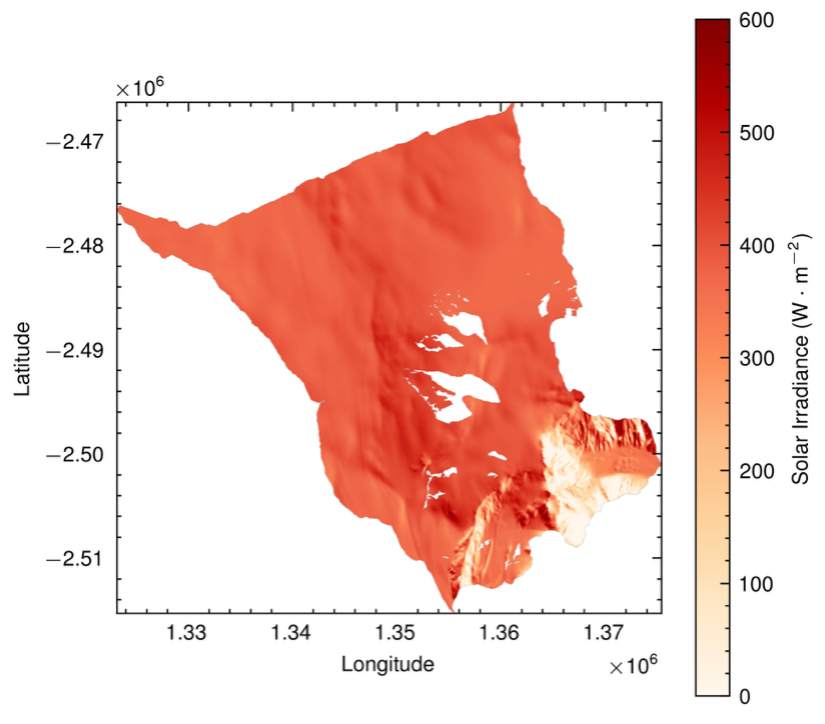
Fig.1: Incoming solar irradiance on 1 April, 2025 at sunset across Breiðamerkurjökull when accounting for the topography. Areas recieving very low- to average solar irradiance often site immediately behind zones with much higher values. This relfects how steep slopes interact with the Sun, where elevated terrain blocks light from some surfaces while taking some of the burnt in the process.
← Back to main page